Oops! Something went wrong while submitting the form.

Carbon fiber and fiberglass begin with very different reinforcement properties. Standard-modulus carbon is much stiffer and less dense than E-glass, so changing the reinforcement changes the stiffness-and-mass budget of the face laminate. That still does not tell you which finished paddle has more spin, pop or control—the laminate, surface, core and geometry still matter.
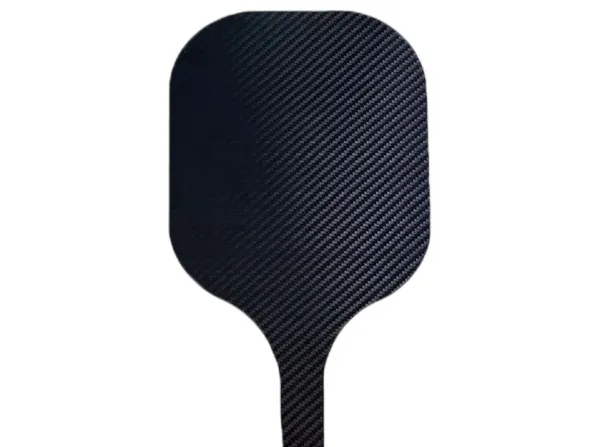

The difference is already substantial at the fiber level, before resin, fabric architecture and layup are added. The numbers below are material references, not paddle-performance scores. E-glass is one common glass-fiber grade; other glass fibers differ.
A fiberglass face is not simply a carbon face made from a different cloth. Fabric weight, fiber direction, resin pickup and supporting plies can all change when the reinforcement changes.

Carbon and fiberglass are reinforcement families below the contact surface. The ball meets the completed face after resin finish, printing, texture or coating have been applied.
Printing, peel-ply texture, coating, resin finish and wear state can change what the ball actually touches.
The current manufacturer test plan lists coefficient of friction, deflection, reflection/gloss and roughness as finished-paddle tests.
A raw carbon sample and a painted fiberglass panel do not isolate the effect of fiber family. For the full face/core/finish map, see what pickleball paddles are made of.
“Fiberglass face” and “contains fiberglass” are not interchangeable descriptions. The layer position matters.
Mozkuib has a confirmed four-layer route with T700 on the outside, two T300 supporting layers and fiberglass underneath. In that build, glass fiber changes the laminate even though the visible striking face is carbon.
That is why a spec sheet should say where the fiberglass sits, not only that the paddle “contains fiberglass.”
For commercial carbon face and layup options, see Mozkuib carbon fiber paddle builds.
The material name tells you something important about the face, but not the finished-paddle result.
| Question | What the material tells you first | What you still need to check |
|---|---|---|
| Face stiffness / flex | Standard-modulus carbon starts from a much higher fiber-modulus baseline than E-glass. | Fabric weight, orientation, resin fraction, ply count, bonding and cure. |
| Face mass | E-glass is denser at the fiber level; standard-modulus carbon provides much more stiffness relative to fiber density. | Fabric gsm, resin pickup, layer schedule and the finished-weight target. |
| Spin / traction | No reliable winner follows from the fiber family name alone. | Finished texture or coating, wear state, ball and test method. |
| Pop / control / contact feel | The face family can shift laminate compliance and response. | Core, body thickness, perimeter treatment, handle connection, balance and total mass. |
| Durability | Fiber properties contribute to laminate stiffness and strength. | Matrix adhesion, impact damage, edge construction, surface wear, layer order and QC. |
For a useful carbon-versus-fiberglass comparison, read the face material together with the laminate, surface and core.
Fiber datasheets describe material properties. They do not replace evidence from finished paddles built to the same comparison brief.
Send the outline, core, body thickness, target weight and finished-surface reference. Mozkuib can flag which variables should stay fixed and which face-schedule changes need to be documented before sampling.


