Oops! Something went wrong while submitting the form.

A paddle sold as “Kevlar” can still use carbon supporting layers under the outer face. Before comparing it with a carbon-face paddle, check what the outer fiber is, what sits underneath it, and what surface the ball actually contacts.
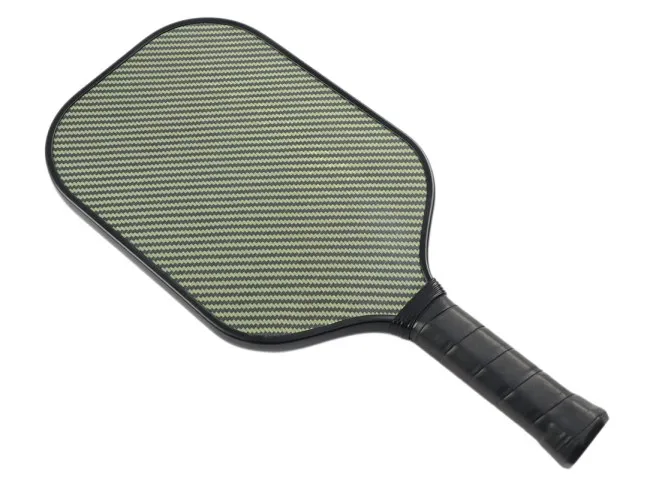
“Aramid,” “Kevlar®” and “Kevlar face” are related terms, but they are not interchangeable specifications.
The generic fiber family. If the supplier sheet confirms aramid but not a specific branded fiber, aramid is the accurate description.
Kevlar® is a trademarked aramid-fiber brand in Arclin’s current aramids portfolio. Color or weave alone is still not proof that a paddle uses the branded fiber.
This still leaves the backing plies, resin, core, body thickness and finished surface open. Those details belong to the construction, not the material nickname.

An aramid outer face does not tell you what the supporting plies are. A hybrid build can use aramid on top and carbon underneath, so the layer schedule matters.

Kevlar® 29 and Kevlar® 49 are different products, and their published modulus values differ. That alone is enough to show why “Kevlar®” should not be read as one mechanical specification for a paddle face.
Toray-DuPont lists representative tensile modulus values of 70.5 GPa for Kevlar® 29 and 112.4 GPa for Kevlar® 49. Toray lists T700S carbon fiber at 230 GPa. These are material references, not finished-paddle results.
Sources: Arclin lists K29 and K49 as separate Kevlar® products. Toray-DuPont lists representative modulus values of 70.5 GPa for Kevlar® 29 and 112.4 GPa for Kevlar® 49; Toray lists T700S fiber tensile modulus at 230 GPa. These values describe the materials, not matched paddles.
Feel, spin and durability are different questions. To compare any of them, keep the rest of the build as close as possible, then use a test that matches the claim.
Keep the core, body thickness, mass and balance matched. Then compare impact response, vibration or deflection with the same method.
Look at the finished surface: coefficient of friction, roughness, coating/texture and wear state. The dry fiber name is not the contact surface.
Define the failure mode before testing: surface retention, impact damage, delamination, edge failure or whole-paddle life are different questions.
USA Pickleball’s current manufacturer test plan lists coefficient of friction, deflection, reflection/gloss and roughness as separate finished-paddle tests.
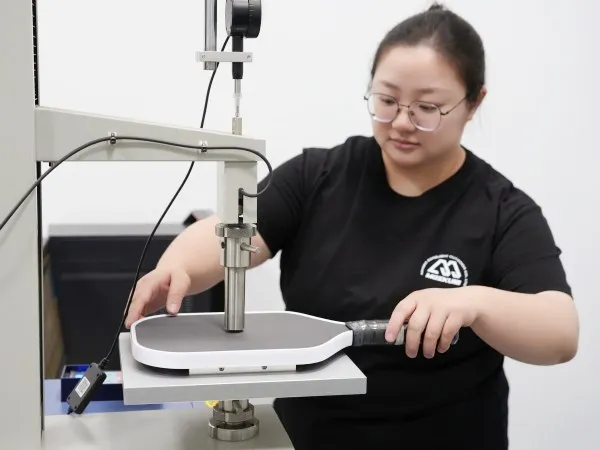
A photo can show the two paddles, but it cannot prove that only the face material changed. For a useful comparison, keep the rest of the build matched and record any exception.

Send the material sheet or a clear face photo, plus any target layup, core and surface requirements. We can check the face material first, then build the sample brief around the full construction.


