
What Does “Thermoformed” Mean on a Pickleball Paddle?
On a pickleball paddle, thermoformed refers to forming the paddle body in a heated mold under pressure. It does not, by itself, tell you what fills the center, whether foam is used around the perimeter, whether the paddle is also described as unibody, or how the finished paddle will play.

Thermoformed is a process, not a complete paddle spec
Several construction labels can appear on the same paddle without meaning the same thing.
A “thermoformed carbon fiber paddle,” for example, combines two different descriptors: thermoformed tells you about the molding process; carbon fiber tells you about the face material.
A paddle can be thermoformed and still have a polypropylene honeycomb center. Foam may sit only around the perimeter. A product description may also use the word unibody while listing the core, edge construction and surface separately.
Selkirk’s SLK HALO Power is a current example. Its specifications include a Thermoformed UniBody Design, a FlexFoam Perimeter, a Polymer Honeycomb Core and an EdgeSentry edge guard.
Those details belong to the same paddle, but one label does not replace the others. So do not read “thermoformed” as shorthand for “full foam.” Unibody is another construction description, not a synonym for thermoformed.
Thermoformed and cold-pressed paddles reach the finished shape differently
Two finished paddles can look surprisingly similar. The manufacturing difference is easier to see before the outline and body are complete.

Thermoforming happens in the mold
On Mozkuib’s hot-press line, the face sheets, core and handle structure are assembled before the paddle enters the mold.
The assembled structure is then formed in the mold under controlled heat and pressure. In the process shown here, that molding stage is the thermoforming step.
For the rest of the hot-press sequence—from face-sheet preparation through finishing and factory checks—see How Pickleball Paddles Are Made.
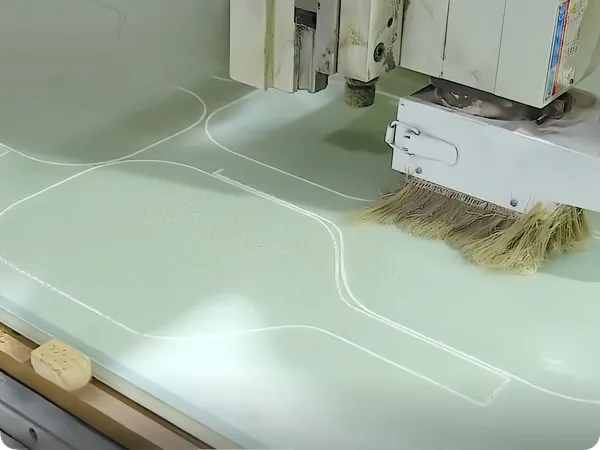
CNC sets the outline on Mozkuib’s cold-pressed line
On Mozkuib’s cold-pressed line, CNC cutting can set different paddle outlines. PP honeycomb is a common core option on that line.
That difference is real, but it is not a quality ranking. Paddletek currently describes its Bantam GTO-C as cold-pressed in the USA “for elite consistency,” and the 14.3 mm GTO-C appears on the current UPA-A approved paddle list.
Cold-pressed therefore does not automatically mean recreational, just as thermoformed does not automatically mean better.
Are thermoformed pickleball paddles better?
Not from that label alone.
Two thermoformed paddles can still differ in core, perimeter structure, face layup, surface, thickness, shape and finished weight. Those differences still matter when you compare the finished paddles.
A manufacturer may pair thermoforming with other design choices intended to change power or feel. That does not make the molding process itself a universal power, control, sweet-spot or durability rating.
If you are comparing two paddles, look past the process name before deciding what the finished paddle is likely to feel like.
A hollow or crunchy sound does not tell you what failed
Players often use “delamination” as a catch-all word when a paddle starts sounding or feeling different. But similar sounds, soft spots and response changes can come from different internal problems.
A crunchy area, soft spot, hollow sound or change in ball response tells you something has changed. It does not tell you which internal part failed.
Tests published by Pickleball Science found damaged thermoformed paddles with more than one possible internal cause, including core, adhesive and face-sheet problems. John Kew makes the same practical distinction between core crushing, disbonding and true delamination.
If the paddle has changed noticeably, compare it with a known-good example when possible. If the difference persists or the face feels unusually soft, loose or inconsistent, contact the manufacturer rather than continuing to guess from the sound alone.
Sources and production basis
Mozkuib’s hot-press details come from our photographed production process, and the cold-press statements are limited to current CNC and core capabilities. Market examples and failure terminology are checked against the manufacturer pages and independent references below.
- Selkirk — SLK HALO Power: current specifications list thermoformed unibody design, perimeter foam, polymer honeycomb core and edge guard separately.
- Paddletek — Bantam GTO-C: current product page identifies the GTO-C as cold-pressed.
- UPA-A — Approved Paddles: current approved-paddle listing includes the GTO-C 14.3 mm.
- Pickleball Science — Thermoformed Paddle Delamination Revisited: damaged-paddle testing and discussion of multiple possible failure mechanisms.
- John Kew — Delamination vs. disbonding vs. core crushing: practical distinction among core crushing, disbonding and true delamination.


